
Accreditation: Unggul
(0096/SK/LAM Teknik/AM/VIII/2022)
Degree:MT
The Magister Programme in Mechanical Engineering at Universitas Muhammadiyah Surakarta (UMS) is designed to develop professional competence, analytical skills, and innovation in the field of mechanical engineering. As one of Indonesia’s progressive graduate programmes, it provides a strong academic environment that integrates applied research, interdisciplinary collaboration, and practical problem solving. The programme equips students with advanced theoretical knowledge and methodological skills, preparing them to contribute effectively to industry, academia, and society. Graduates are expected to demonstrate professional ethics, creativity, and the ability to address engineering challenges in alignment with Islamic and Muhammadiyah values..
Vision: Pada tahun 2029 menjadi pusat unggulan tridharma bidang teknologi manufaktur otomotif yang berkontribusi pada pengembangan ilmu pengetahuan dan teknologi sejalan dengan nilai-nilai keislaman dan kemuhammadiyahan. (SK Rektor UMS 238.1/II/2022)
By the year 2029, to become a center of excellence in the tridharma (three pillars of higher education) in the field of automotive manufacturing technology, contributing to the advancement of science and technology in alignment with Islamic and Muhammadiyah values.
Program Educational Objectives (PEO)
The following Program Educational Objectives (PEOs) describe the expected achievements of graduates within a few years after completing the Magister Programme in Mechanical Engineering, presented in both Bahasa Indonesia and English.
| PEO | Deskripsi (Description) |
|---|---|
| PEO 1 | Lulusan memliki kompetensi di bidang teknik mesin atau bidang keteknikan yang relevan, serta menjunjung tinggi nilai etika profesi. (Graduates possess competencies in mechanical engineering or relevant engineering fields, and uphold professional ethics.) |
| PEO 2 | Lulusan berkompeten mengembangkan riset dan teknologi berbasis kearifan lokal dengan interaksi multidisiplin. (Graduates are competent in developing research and technology based on local wisdom through multidisciplinary interaction.) |
| PEO 3 | Lulusan mempunyai kontribusi dan sumbangan yang nyata bagi masyarakat, serta berperilaku kecendekiawan. (Graduates make tangible contributions and donations to society, and behave in an intellectual manner.) |
| PEO 4 | Lulusan mempresentasikan dan mempublikasikan karya penelitiannya dengan percaya diri dan menerima hibah dari proposal penelitian. (Graduates confidently present and publish their research work and successfully obtain research grants through proposal submissions.) |
Program Learning Outcomes (PLO)
The Program Learning Outcomes (PLO) table with each description in Bahasa Indonesia followed by its English translation in brackets
| PLO | Deskripsi (Description) |
|---|---|
| PLO 1 | Memiliki tanggung jawab atas pekerjaan yang diemban secara mandiri dan mencerminkan sikap religius yang konsisten. [Demonstrates responsibility for assigned tasks independently and consistently reflects religious values..] |
| PLO 2 | Memiliki kemampuan bekerja sama dalam tim kerja serta mengedepankan prinsip etika profesi. [Exhibits teamwork skills and prioritizes professional ethics..] |
| PLO 3 | Memiliki kreativitas dan jiwa inisiatif dalam setiap tugas yang diembannya. [Displays creativity and initiative in every assigned task..] |
| PLO 4 | Mengembangkan jaringan kerja (networking) dan Kerjasama dalam tim multidisiplin dengan mengedepankan komunikasi yang efektif. [Developing networking and cooperation within multidisciplinary teams by prioritizing effective communication.] |
| PLO 5 | Menerapkan pengetahuan keteknikan otomotif manufaktur dan penggunaan analisis matematika untuk menyelesaikan masalah industry dan masyarakat yang berkaitan dengan otomotif manufaktur melalui penelitian yang terencana. [Applying automotive manufacturing engineering knowledge and mathematical analysis to solve industry and community problems related to automotive manufacturing through planned research. ] |
| PLO 6 | Mengidentifikasi, menganalisis, merumuskan dan menyelesaikan masalah bidang otomotif manufaktur yang melibatkan berbagai bidang ilmu dan Menyusun roadmap pengembangan lanjut. [Identify, analyze, formulate, and solve problems in the field of automotive manufacturing involving various fields of science and develop a roadmap for further development.] |
| PLO 7 | Mengembangkan kapasitas kompetensi keteknikan secara mandiri dan kolegial kesejawatan, serta mengevaluasi dan mendokumentasi hasil pekerjaan berbasis sistem informasi. [Develops engineering competencies independently and collegially, while evaluating and documenting work outcomes using information systems.] |
| PLO 8 | Melakukan rekayasa teknologi dan pengembangan sistem, proses dan komponen otomotif manufaktur berbasis kemajuan teknologi terkini dengan mengoptimalkan sumber daya yang tersedia dan memperhitungkan batasan yang ada. [Conducts technological engineering and develops systems, processes, and components in automotive manufacturing based on current technological advancements, optimizing available resources and considering existing constraints.] |
| PLO 9 | Merencanakan penelitian yang berkontribusi pada keilmuan bidang otomotif manufaktur secara komprehensif dengan mengikuti perkembangan teknologi. [Plans research that contributes comprehensively to the field of automotive manufacturing science in line with technological developments.] |
| PLO 10 | Melaksanakan penelitian yang bermanfaat bagi masyarakat atau industri, mengacu pada hasil riset yang teruji dengan mempertimbangkan efisiensi dan nilai tambah serta menggunakan piranti terkini dan modern. [Conducts research beneficial to society or industry, based on validated findings, considering efficiency and added value, and utilizing modern tools.] |
| PLO 11 | Mengaplikasikan teori dasar rekayasa material, manufaktur, energi dan otomotif sesuai bidang kerja, ketersediaan sumber daya dan perkembangan teknologi. [Applying basic theories of materials engineering, manufacturing, energy, and automotive engineering in accordance with the field of work, availability of resources, and technological developments.] |
| PLO 12 | Menggunakan sistem pembelajaran berbasis riset untuk pengembangan keilmuan secara berkesinambungan dengan media luring maupun daring memanfaatkan berbagai sumber yang sahih dan terpercaya. [Uses research-based learning systems for continuous scientific development through offline and online media, utilizing credible and reliable sources.] |
🌐 Integrated Research Ecosystem
At the heart of the programme lies a vertically integrated research structure that connects undergraduate, master’s, and doctoral levels. This seamless academic pipeline fosters collaboration across disciplines and generations, allowing doctoral candidates to lead high-impact studies while mentoring junior researchers.
UMS hosts several specialized research groups that drive innovation and inquiry:
- MAPROTEC – Focused on manufacturing processes and technology.
- ASER – Dedicated to sustainable energy and renewable systems.
- AMAS – Advances in materials science and applications.
- AVEC – Vehicle engineering and control systems.
- FAERO – Fluid and aerodynamics research.
These groups provide a vibrant platform for postgraduate students to engage in collaborative projects, publish impactful research, and contribute to national and global engineering challenges. The synergy between teaching and research ensures that doctoral insights not only shape dissertations but also enrich the broader academic communit
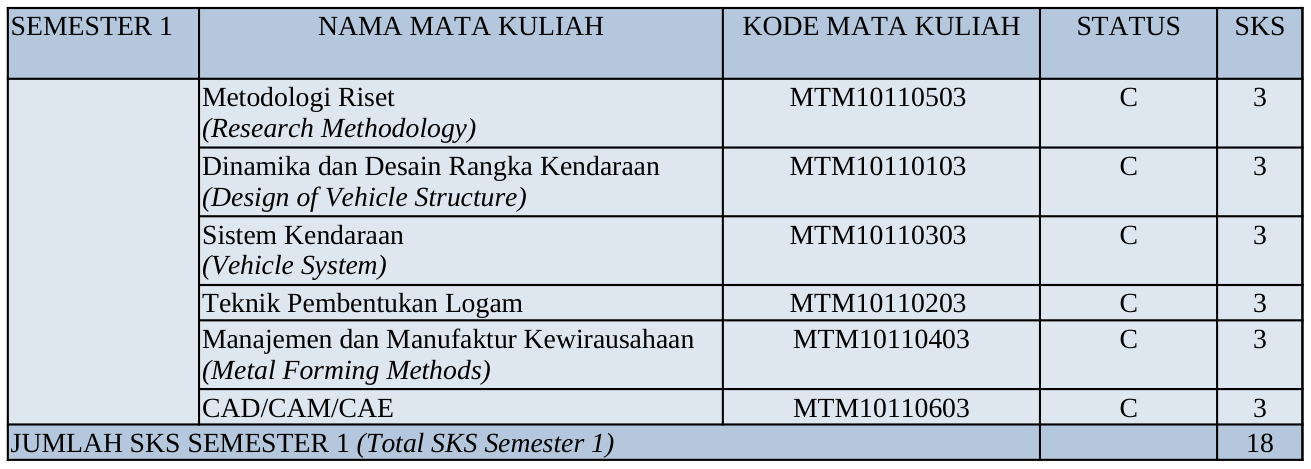
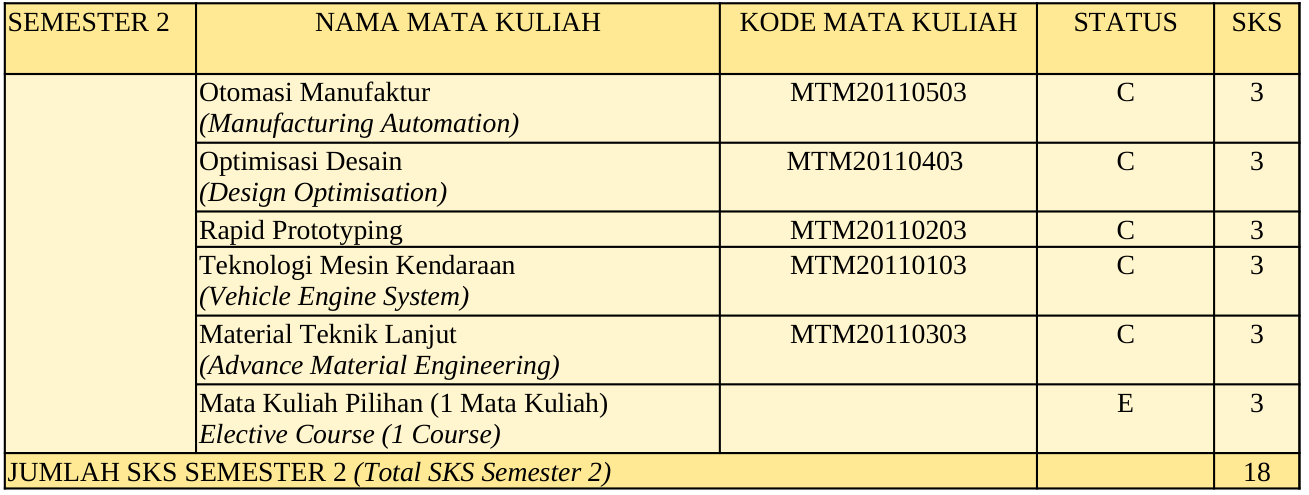
The following curriculum structure outlines the progression of courses and research components across three semesters in the Magister Programme in Mechanical Engineering at Universitas Muhammadiyah Surakarta, designed to foster advanced expertise and scholarly excellence.
(SK Rektor UMS 238.2/II/2022)
The curriculum, structured over three semesters, consists of Compulsory Courses (C) to build foundational knowledge, Elective Courses (E) for specialization, a Thesis (T) to demonstrate original research, and a Thesis and Examination (T, E) to assess academic and research competence.
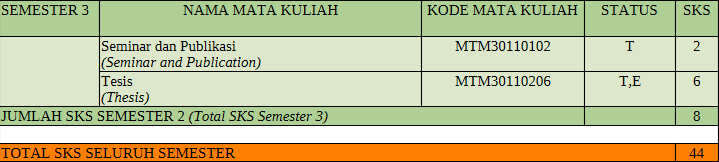
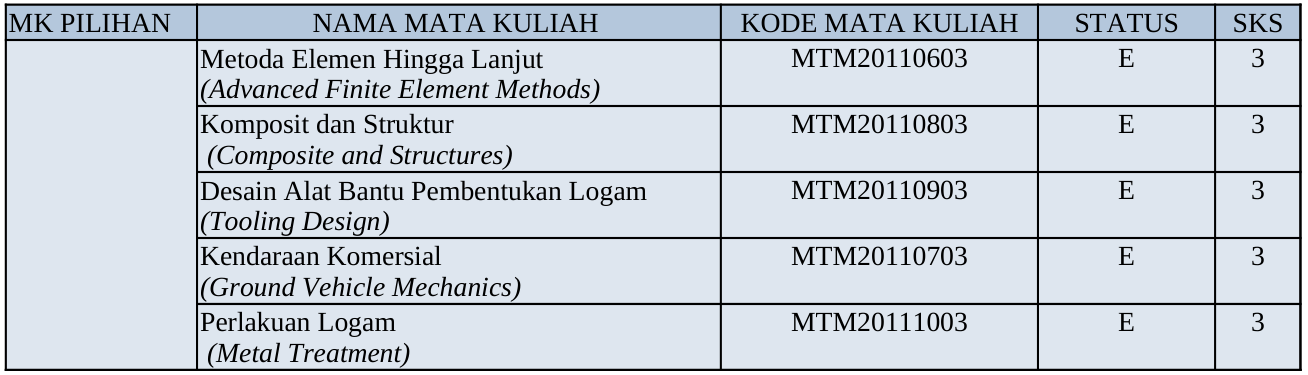
To qualify for admission into the magister programme, applicants must meet the following academic and administrative criteria: (35/FT/VII/2023)
Academic Qualifications
- Hold a Bachelor's degree (S1) in Mechanical Engineering or a closely related field from an accredited recognised university.
- Minimum GPA of 3.00 (on a 4.00 scale) from fresh graduate Bachelor’s programme. (*)
Standardized Test Scores
- TOEFL score of at least 450 (scale 0-600, or equivalent English proficiency certification). (**)
- TPA (Tes Potensi Akademik) score of at least 450 (scale 0-700). (***)
(*) At least GPA 2.75 with minimum two years working experience in relevant mechanical engineering field
(**) Test exemption granted upon submission of valid TPA certificate.
(***) Test exemption granted upon submission of English proficiency certificate (TOEFL, IELTS, Duolingo, or British Council EnglishScore).
The tuition fee for the Magister Programme in Mechanical Engineering at Universitas Muhammadiyah Surakarta (UMS) is IDR 8,900,000 per semester. This fee covers academic lectures, tuition fee, dissertation supervision, proposal defend, examination, and access to research facilities.
Additional costs may apply for publication, or laboratory usage depending on the student's research focus. UMS is committed to providing a high-quality doctoral experience with strong academic support and a vibrant research environment.